

















Soup
Traditional Posole
 4.9 · 87 reviews

If you grew up in New Mexico, this traditional posole is the dish you remember from cold winter evenings and big holiday tables — the same bowl of slow-simmered pork, hominy, and red chile they ladled out at school cafeterias and church suppers. It is humble, hearty, and deeply rooted in the food traditions of our region. Spell it posole the way we do here, or pozole the way you will see it on most menus — it is the same beloved pork-and-hominy stew either way.
This particular recipe comes straight from our family kitchen, where Mom always had a pot going on the stove when the weather turned cool. She made hers with pork tenderloin, and honestly, you can too — but pork shoulder gives you that extra richness that makes the broth absolutely irresistible after a long, slow simmer. Five generations of growing chile in the Hatch Valley have taught us that the best red posole is built on patience and good chile, not a long ingredient list.
What is posole — and why the hominy matters
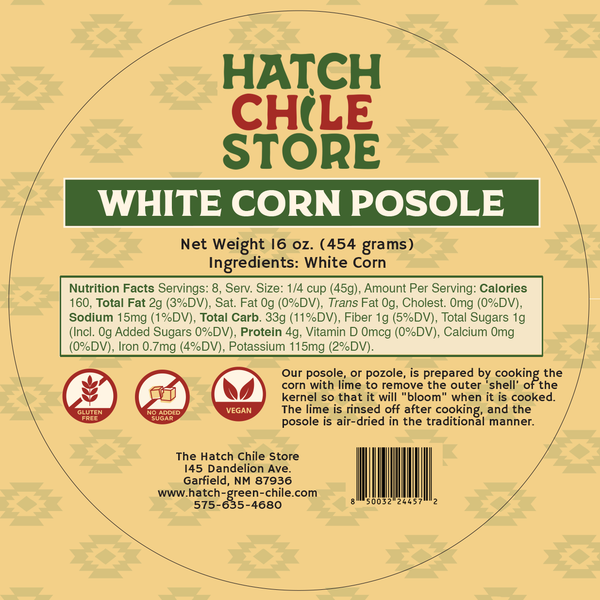
Posole is a brothy stew of pork and hominy — field corn that has been treated with an alkaline solution (nixtamalized) so the hulls slip off and the kernels puff up tender and chewy. That puffed corn is what people mean when they search for “pozole corn” or “corn for pozole.” It is not the same as the canned sweet corn in the soup aisle, and it is not the same as posole made from scratch with dried field corn either. Our posole hominy is the genuine prepared corn this dish is built on — it holds its bite through a long simmer instead of dissolving into mush.
Red posole, the New Mexico way
Most New Mexican posole is posole rojo — red. The earthy, sun-dried flavor comes from Hatch red chile, and that is the single ingredient that decides whether your stew tastes authentic or flat. You can build the red base from our Hatch red chile powder stirred into the broth, or from a jar of our fresh Hatch red chile sauce when you want it done in one move. Either way, no store-bought taco-aisle “enchilada sauce” will get you there — the depth has to come from real New Mexico chile.
Pork, and how to pick it
Pork shoulder (also sold as pork butt) is the cut we reach for. It has enough fat and connective tissue to go silky over a two-hour simmer, and it shreds beautifully at the end. Pork tenderloin or country-style ribs work in a pinch — just know a leaner cut gives you a lighter broth. Brown the pork hard before it goes in the pot; those caramelized edges are free flavor.
Substitutions and a chicken version
Plenty of families make pozole rojo de pollo — red posole with chicken — especially when they want something lighter or faster. Swap the pork for bone-in chicken thighs or a whole chicken, simmer until it pulls apart, and shred it back into the pot. The hominy and red chile stay exactly the same, so you still get authentic chicken pozole without changing the soul of the dish. Want it meatless? Skip the pork entirely and lean on the hominy, red chile, and a good vegetable broth.
Stovetop, slow cooker, or Instant Pot
This recipe is written for the stovetop because that is how Mom made it, but it adapts cleanly. For Instant Pot posole, brown the pork on sauté, add everything, and pressure cook 35 minutes with a natural release — you get the same fork-tender pork in a fraction of the time. In a slow cooker, brown the pork first, then 6–8 hours on low. The chile and hominy are forgiving; only the timing changes.
Toppings, serving, and storage
Posole is a build-your-own bowl. Set out shredded cabbage, thin-sliced radishes, diced onion, a wedge of lime, dried oregano, and warm tortillas, and let everyone dress their own. It is even better the next day — the chile deepens overnight — so make a big pot. It keeps 4 days in the fridge and freezes beautifully for 3 months; add a splash of broth when you reheat. Set this one up in the morning, and by dinnertime your whole house will smell like New Mexico.
Traditional Posole
- Prep20 min
- Cook2 hr 30
- Total2 hr 50
- Serves8 servings
Ingredients

Instructions
- Season the cubed pork with salt. Heat the oil in a large heavy pot over medium-high heat and brown the pork on all sides in batches, then set aside.
- Add the onion to the same pot and cook until soft, about 5 minutes. Stir in the garlic and cook 1 minute more.
- Stir in the red chile powder (or sauce), posole seasoning, oregano, and cumin and toast for 30 seconds until fragrant.
- Return the pork to the pot, add the hominy and broth, and bring to a boil.
- Reduce the heat to low, cover, and simmer 2 to 2 1/2 hours, until the pork is fork-tender and the broth is rich and red. Stir occasionally and skim any foam.
- Taste and adjust salt. Ladle into bowls and serve with cabbage, radishes, onion, lime, and warm tortillas so everyone can dress their own.
Made with Posole (Pozole) | Traditional New Mexico Hominy, grown by our family in the Hatch Valley for five generations.