








Organic vs. Conventional Chile Farming in Hatch Valley
Organic and conventional chile farming in Hatch Valley differ primarily in how growers manage soil fertility, pest pressure, and weed control — organic methods rely on approved natural inputs and biological systems, while conventional methods permit synthetic fertilizers and pesticides. Both approaches can produce the rich, complex flavor Hatch Valley is famous for, but they make meaningfully different trade-offs in cost, yield, labor intensity, and long-term soil health. Understanding those trade-offs helps you make a more informed choice about the green chile you bring to your table.
Why Hatch Valley Is a Unique Growing Environment
The Hatch Valley sits along the Rio Grande in southern New Mexico at an elevation of roughly 4,000 feet. The region receives intense summer sunlight, low humidity, and significant day-to-night temperature swings — conditions that stress the chile plant in precisely the right ways, concentrating capsaicinoids and sugars that define the variety's character. The NMSU Chile Pepper Institute has documented this terroir effect extensively, noting that the same seed planted outside the Hatch microclimate produces measurably different heat levels and Brix readings.
The valley's soils are sandy loam with good drainage, which is ideal for chile roots but also means nutrients can leach quickly. That single fact sits at the heart of the organic vs. conventional debate here: how do you keep nitrogen available to a crop that needs it, in a soil that does not hold it well?
How Conventional Chile Farming Works in Hatch Valley
Conventional farming uses synthetic nitrogen fertilizers — most commonly urea or ammonium nitrate — applied on a timed schedule based on soil tests and crop growth stage. Growers also have access to a broader arsenal of EPA-registered herbicides and insecticides to manage the two most destructive threats to Hatch chile: the beet leafhopper, which vectors curly top virus, and root-knot nematodes.
Key Inputs in Conventional Systems
- Synthetic nitrogen fertilizers — fast-acting, predictable, and relatively inexpensive per acre
- Pre-emergent herbicides — reduce hand-weeding labor significantly
- Systemic insecticides — provide longer residual control of leafhoppers and aphids
- Fumigants such as 1,3-dichloropropene — used to manage nematode populations before transplanting
The USDA Economic Research Service reports that conventional chile operations in New Mexico typically achieve more consistent per-acre yields because synthetic inputs allow growers to respond quickly when nutrient deficiencies or pest outbreaks appear mid-season. That consistency is meaningful in a crop like Hatch chile, where harvest windows are narrow and processors have firm delivery contracts.
How Organic Chile Farming Works in Hatch Valley
Certified organic production — governed by the USDA National Organic Program (NOP) under 7 CFR Part 205 — prohibits synthetic fertilizers, synthetic pesticides, and genetically engineered seed. In the Hatch Valley context, that means organic growers must solve the same soil fertility and pest problems with a more limited and often more expensive toolkit.
Key Inputs and Practices in Organic Systems
- Compost and aged manure — build organic matter and release nitrogen slowly
- Cover crops — legumes like hairy vetch or cowpea fix atmospheric nitrogen before chile transplants go in
- Row covers and reflective mulch — physical barriers that reduce beet leafhopper pressure without chemicals
- Beneficial nematode applications — OMRI-listed biocontrol options for soil pest management
- Crop rotation — rotating out of Solanaceae for two or more seasons reduces nematode and Phytophthora buildup
The NMSU Chile Pepper Institute has published research comparing integrated pest management strategies for organic chile, and their findings consistently show that reflective mulch is one of the most cost-effective tools an organic grower has against curly top virus — because it deters the leafhopper vector before it feeds, rather than killing it after.
Side-by-Side Comparison: Organic vs. Conventional
| Factor | Organic | Conventional |
|---|---|---|
| Nitrogen management | Compost, cover crops, slow-release | Synthetic urea, ammonium nitrate |
| Pest control | Row covers, biocontrols, rotation | Synthetic insecticides, fumigants |
| Weed management | Cultivation, mulch, hand-weeding | Pre- and post-emergent herbicides |
| Typical yield | Lower, more variable | Higher, more consistent |
| Input cost per acre | Higher labor, lower chemical costs | Lower labor, moderate chemical costs |
| Certification requirement | USDA NOP certified, 3-year transition | None required |
| Price premium at market | Typically 20–40% higher | Standard market price |
| Long-term soil health | Generally improving organic matter | Variable; depends on management |
Does Farming Method Affect Flavor?
The honest answer is: not dramatically, and not in isolation. Flavor in Hatch chile is driven primarily by variety, growing location, water stress timing, and harvest maturity. A Big Jim grown in the Hatch Valley under conventional management and a Big Jim grown organically in the same field will taste remarkably similar because the terroir variables dominate.
USDA FoodData Central data on chile peppers does not differentiate nutrient profiles by organic vs. conventional production, and the NMSU Chile Pepper Institute has not documented a consistent, measurable capsaicin difference attributable to farming method alone. What organic management can affect over time is soil microbial diversity, which influences nutrient cycling in ways that may subtly benefit fruit quality — but isolating that effect from variety and weather is methodologically difficult.
Specific Hatch Chile Varieties and Farming Considerations
Different varieties within the Hatch designation respond differently to organic management. Here is how some of the most popular names play out on the farm:
Big Jim
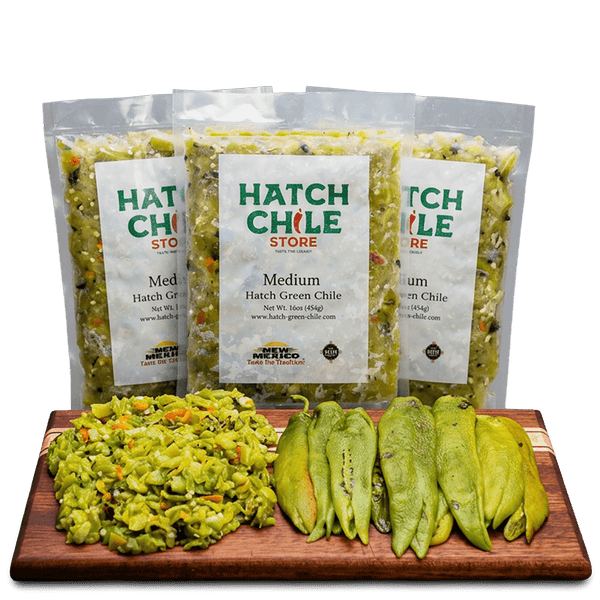
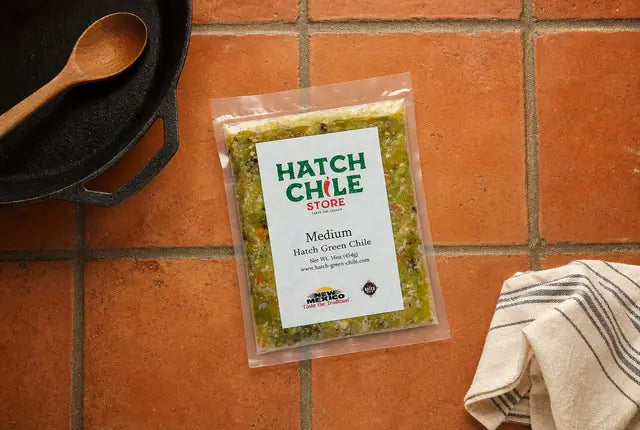
The workhorse of the Hatch Valley. Its large fruit size means it needs consistent nitrogen availability at fruit set. Organic growers often use a compost tea side-dress at transplanting to bridge the gap before cover crop residue mineralizes. Our Medium roasted green chile is now Charger, the variety that is replacing Big Jim.
NuMex Heritage 6-4
Developed by the NMSU Chile Pepper Institute to replicate the original Hatch 6-4 flavor profile, this variety performs well under both systems but benefits particularly from the slower nitrogen release of organic compost, which seems to reduce excessive vegetative growth and push more energy into pod development.
Sandia
A hotter variety that tends to be more sensitive to water and nutrient fluctuations. Conventional growers can fine-tune fertility precisely with soluble synthetic nutrients. Organic growers working with Sandia need well-developed soil biology before they plant.
Lumbre
One of the hottest Hatch varieties commercially available. Lumbre's capsaicin production is responsive to drought stress — a management lever available to both organic and conventional growers equally.
Our Approach on the Family Farm
Our family has grown chile in the Hatch Valley for five generations. You can read more about our family farm and the history that shapes how we think about the land. If you want to know more about our family's farming story, we share that story openly.
The Bottom Line
No single method has a monopoly on good chile. Good chile comes from good seed, good water management, and deep knowledge of this particular stretch of New Mexico river bottom. Everything else is in service of that.
Frequently Asked Questions
Is organic Hatch chile always better than conventionally grown?
Not necessarily. Flavor in Hatch chile is driven primarily by variety, terroir, water stress timing, and harvest maturity — not farming method alone. Both organic and conventional Hatch chiles can be exceptional when grown by experienced farmers in the Hatch Valley. Organic certification speaks to how the crop was managed, not to a guaranteed flavor outcome.
What does USDA organic certification require for a Hatch Valley chile farm?
Under 7 CFR Part 205 of the USDA National Organic Program, a farm must complete a three-year transition period during which no prohibited substances are applied to the land. After that, the operation must be inspected and certified annually by an accredited certifying agent, maintain detailed records of all inputs and practices, and use only OMRI-listed or NOP-approved materials for fertility and pest management.
Do organic chile farms produce lower yields than conventional farms?
Generally, yes. Organic chile operations in New Mexico typically see more variable per-acre yields because organic fertility inputs release nutrients more slowly and organic pest control tools are often less immediately effective than synthetic alternatives. However, the yield gap varies significantly by year, soil health, and farmer skill level — experienced organic growers narrow it considerably over time as soil biology improves.
Which Hatch chile varieties are best suited to organic production?
NuMex Heritage 6-4 and Big Jim are the varieties most commonly grown organically in the Hatch Valley. Both have broad adaptability and tolerate the slower nitrogen release typical of compost-based fertility programs. Hotter, more stress-sensitive varieties like Sandia require more established soil biology before organic management works reliably.
How can I tell if the Hatch chile I am buying was grown organically?
Look for a USDA Certified Organic label or ask the grower directly for their NOP certification number. In New Mexico, the New Mexico Department of Agriculture administers organic certification for many in-state farms. Reputable Hatch Valley sellers will be transparent about their production methods. At our family farm, we are always happy to answer questions about how our chile is grown.